
1. A Moment That Stopped Time
On August 23, 2023, at precisely 18:04 IST, millions across India—and observers worldwide—paused in anticipation. In offices, classrooms, and homes, attention converged on a single question: Would India successfully achieve a soft landing on the Moon?
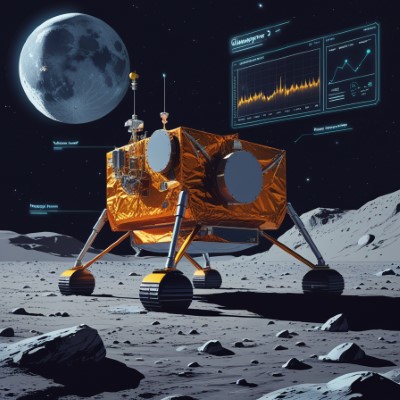
Moments later, confirmation arrived: the Indian Space Research Organisation had successfully landed the Chandrayaan-3 mission near the Moon’s south pole using the Vikram Lander. Soon after, the Pragyan Rover rolled onto the lunar surface.
This achievement was historic:
- First-ever soft landing near the lunar south pole
- A major redemption after the Chandrayaan-2 setback
- A demonstration of high-impact engineering under budget constraints
For engineers—especially electrical and electronics engineers—this mission is not just a national milestone, but a case study in system design, sensing, thermal engineering, and embedded intelligence.
2. The 14-Day Constraint: Engineering vs Environment
Unlike Earth, the Moon has extreme day-night cycles:
- ~14 Earth days of sunlight
- ~14 Earth days of darkness
During lunar night, temperatures can plummet to –200°C, making survival extremely challenging for:
- Batteries
- Electronics
- Structural materials
Despite this, ISRO designed Chandrayaan-3 to:
- Operate efficiently during the 14-day daylight window
- Enter sleep mode before sunset
- Attempt revival at sunrise via solar panel alignment and fully charged batteries
However, revival did not occur—highlighting a critical engineering challenges.
3. Seismic Surprise: Detecting Lunar Vibrations
One of the most fascinating aspects of the mission was the deployment of the Instrument for Lunar Seismic Activity (ILSA).
What ILSA Detected:
- Unexpected vibration patterns
- Periodic signals lasting ~14 minutes
- Non-random seismic signatures
Why This Was Surprising:
The Moon has long been considered:
- Geologically inactive
- Structurally rigid
- Thermally dead
Yet, these vibrations suggested otherwise.
Engineering Perspective:
ILSA is essentially a multi-axis high-sensitivity vibration sensing system, similar to:
- MEMS accelerometers
- Geophysical seismometers
It can detect:
- Micro-scale surface disturbances
- Long-range vibration propagation
Initial Confusion:
Was it:
- Rover movement?
- Lander activity?
- Natural seismic events?
Detailed signal pattern comparison confirmed:
These were not caused by mission operations
4. Moonquakes Explained: The Shrinking Moon
By 2026, NASA validated ISRO’s seismic data and provided a critical explanation:
Root Cause: Thermal Contraction
- The Moon is gradually cooling internally
- As it cools, it contracts
- This contraction leads to:
- Surface cracking
- Fault formation
- Seismic vibrations (moonquakes)
Engineering Analogy:
Think of:
- Cooling metal structures shrinking
- Thermal stress causing micro-fractures
This is a planetary-scale version of the same phenomenon.
The Moon is not dead—it is aging and evolving structurally.
5. Extreme Thermal Gradient: A Design Revelation
The ChaSTE (Chandra’s Surface Thermophysical Experiment) instrument delivered a breakthrough:
Measured Data:
- Surface temperature: ~+70°C
- At 10 cm depth: ~–168°C
Key Insight:
The lunar soil (regolith) is:
- A poor thermal conductor
- Highly insulating
Why This Matters:
For future lunar base design:
- Subsurface structures can remain extremely cold
- Surface heat does not penetrate deeply
- Artificial heating inside habitats can be retained
Engineering Implication:
This opens pathways for:
- Thermally efficient underground habitats
- Reduced energy consumption for temperature control
6. Laser Spectroscopy: Real-Time Soil Analysis
The Pragyan rover used LIBS (Laser-Induced Breakdown Spectroscopy)—a powerful tool for in-situ material analysis.
Working Principle:
- High-energy laser pulse hits soil/rock
- Plasma is generated
- Emitted light spectrum is analyzed
- Elemental composition is determined
Detected Elements:
- Sulfur (first-ever detection on lunar surface in-situ)
- Aluminium
- Calcium
- Iron
- Titanium
- Silicon
- Oxygen
- Trace hydrogen
Why This Is Revolutionary:
Unlike previous missions:
- No need to bring samples back to Earth
- No contamination from Earth’s atmosphere
Electrical Engineering Angle:
LIBS integrates:
- High-power pulsed lasers
- Optical sensors
- Signal processing systems
- Embedded spectral analysis algorithms
7. Sulfur Discovery: Evidence of a Dynamic Past
The detection of sulfur is particularly important.
Scientific Implication:
Sulfur presence suggests:
- Past volcanic activity
- Internal heat-driven processes
This challenges the long-standing belief that:
The Moon has always been geologically inactive
8. Ancient Craters: A Window into Lunar Formation
Chandrayaan-3 also identified:
- A ~4.3 billion-year-old crater near the south pole
Why It Matters:
- Contains primordial materials
- Preserves early Solar System history
New Understanding:
During Earth’s early life formation:
- The Moon likely had:
- Flowing lava
- High thermal activity
- Similar geological processes as early Earth
Key Insight:
The Moon and Earth likely share a common origin, supporting the giant impact hypothesis.
9. Why Data Was Not Immediately Released
Some critics questioned:
- Why ISRO delayed releasing detailed findings
Scientific Reality:
In space research:
- Initial data is preliminary
- Requires:
- Calibration
- Validation
- Peer review
Especially for:
- First-time detections (e.g., sulfur, hydrogen traces)
Premature release could lead to:
- Misinterpretation
- Scientific inaccuracies
10. Engineering Philosophy of ISRO
A key takeaway for engineering students:
ISRO’s Core Strength:
Maximum impact with minimal resources
Examples:
- Mars Orbiter Mission (low-cost interplanetary success)
- Chandrayaan-3 (high-precision landing under budget constraints)
Design Principles:
- Simplicity over complexity
- Reliability over redundancy
- Optimization over over-engineering
11. Lessons for Electrical Engineering Students
Chandrayaan-3 is a goldmine of learning:
1. Sensor Systems
- Seismic sensors (ILSA)
- Thermal probes (ChaSTE)
- Spectroscopy (LIBS)
2. Embedded Systems
- Autonomous navigation
- Real-time decision-making
3. Power Electronics
- Solar energy harvesting
- Battery management in extreme conditions
4. Signal Processing
- Noise filtering
- Pattern recognition
- Spectral analysis
5. Thermal Engineering
- Heat insulation
- Survival under cryogenic conditions

12. Final Perspective: 14 Days That Changed Lunar Science
In just 14 Earth days, Chandrayaan-3 achieved:
- First south pole landing
- Detection of moonquakes
- Discovery of extreme thermal gradients
- First in-situ sulfur detection
- Insights into lunar evolution
These are not incremental findings—they are paradigm-shifting discoveries.
Conclusion
Chandrayaan-3 is more than a mission—it is a case study in engineering excellence, scientific curiosity, and strategic thinking.
For students and researchers, it delivers a powerful message:
You don’t need unlimited resources to achieve extraordinary results—
you need clarity, innovation, and precision engineering.
As we move toward future missions like Chandrayaan-4, one thing is certain:
The Moon still holds secrets—and India is now at the forefront of uncovering them.