
Technology, Electric Propulsion, and the Future of Urban Air Mobility
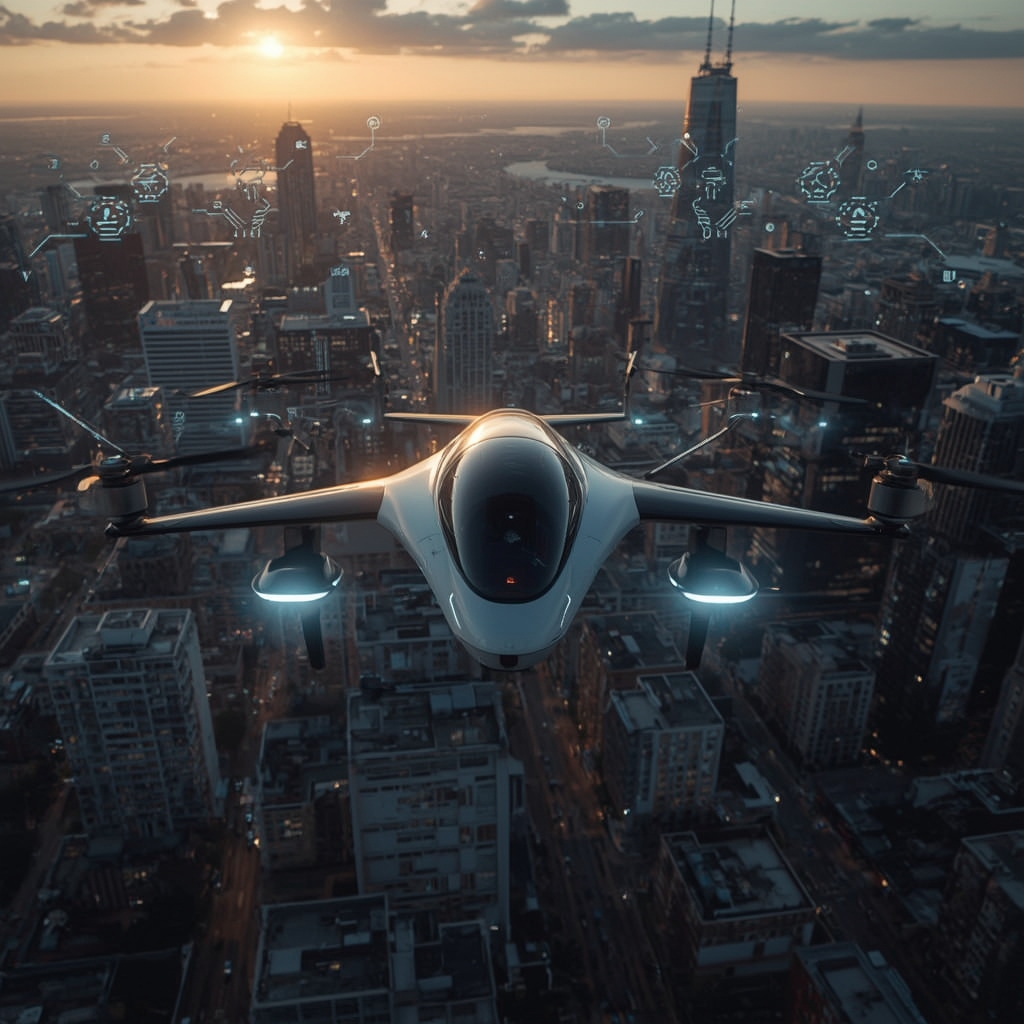
The aviation industry is undergoing one of its most significant technological transitions since the introduction of jet engines. At the center of this transformation is the concept of Electric Vertical Take-Off and Landing (eVTOL) aircraft—electric-powered flying vehicles capable of taking off and landing vertically like helicopters while cruising efficiently like airplanes. Electric vertical take‑off and landing
Driven by advances in electric propulsion, high-energy batteries, power electronics, and lightweight materials, eVTOL aircraft are expected to become the backbone of Advanced Air Mobility (AAM) and Urban Air Mobility (UAM) systems. These aircraft promise quieter operation, lower emissions, and reduced operating costs compared with traditional helicopters.
For electrical engineers—especially those working in electric machines, power electronics, and control systems—the eVTOL sector represents one of the most exciting multidisciplinary engineering frontiers.
This article explores:
- The fundamentals of eVTOL technology
- Electric propulsion architecture and electric machines
- Power electronics and battery systems
- Aircraft design architectures
- Leading companies and projects
- Key challenges and future directions
1. What Are eVTOL Aircraft?
An eVTOL aircraft is an aircraft capable of vertical take-off and landing using electric propulsion systems. Unlike conventional airplanes that require runways, eVTOLs can operate from small landing pads, rooftops, or specialized “vertiports.”
These aircraft combine characteristics of:
- Helicopters (vertical lift)
- Airplanes (efficient forward flight)
- Drones (distributed electric propulsion)
Most designs target short-distance urban trips ranging from 20–150 km, making them ideal for urban commuting and regional mobility.
Typical applications include:
- Urban air taxis
- Medical evacuation
- Cargo delivery
- Regional transport
- Military mobility
The sector has attracted more than $10 billion in investment worldwide, highlighting its strategic importance.
2. Core Technologies Behind eVTOL
The rapid emergence of eVTOL aircraft has been enabled by advances in several engineering domains.
2.1 Distributed Electric Propulsion (DEP)
Most eVTOL designs use Distributed Electric Propulsion (DEP)—multiple electric motors distributed across wings or rotors.
Advantages include:
- High redundancy and safety
- Improved control authority
- Reduced mechanical complexity
- Increased aerodynamic efficiency
Unlike traditional helicopters that rely on a single large rotor, eVTOLs may use 8–20 electric propulsors.
Example: Some modern prototypes employ up to 20 lift motors for redundancy and performance.
3. Electric Machines in eVTOL Propulsion
Electric propulsion is the heart of eVTOL aircraft, making electric machines one of the most critical components.
Key requirements for eVTOL electric motors
Compared to automotive motors, aerospace electric motors require:
- Extremely high power density
- High efficiency (>95%)
- Low weight
- High reliability
- Redundant architecture
Typical power requirements for passenger eVTOL aircraft:
| Parameter | Typical Value |
|---|---|
| Total power | 300 kW – 1 MW |
| Motor power | 20–100 kW per motor |
| Power density | 5–15 kW/kg |
Motor Types Used
- Permanent Magnet Synchronous Motors (PMSM)
- Axial Flux Motors
- High-speed radial flux motors
Axial flux machines are especially attractive because they offer:
- High torque density
- Compact pancake-like geometry
- Reduced weight
These characteristics make them suitable for distributed propulsion systems.
4. Power Electronics Architecture
Power electronics plays a critical role in converting battery power into controlled electrical power for propulsion.
Typical architecture:
Battery Pack
↓
DC Bus
↓
Inverter (SiC-based)
↓
Electric Motor
↓
Propeller / Rotor
High-voltage DC architectures are preferred because they reduce cable weight and improve system efficiency.
Typical Electrical System Parameters
| Parameter | Range |
|---|---|
| DC Bus Voltage | 600 – 1000 V |
| Inverter Technology | SiC MOSFET |
| Motor Speed | 2000 – 8000 rpm |
| Efficiency | >95% |
Modern eVTOL designs rely heavily on:
- Silicon Carbide (SiC) inverters
- Advanced thermal management
- Fault-tolerant architectures
5. Battery Systems for eVTOL
Battery technology remains one of the most critical limitations.
Most current designs rely on Lithium-ion batteries, which offer energy densities between:
200–300 Wh/kg
However, eVTOL aircraft require:
- High discharge rates during take-off
- Fast charging
- Long cycle life
Battery performance modeling is crucial because high discharge rates during take-off significantly affect degradation and thermal behavior.
Future candidates include:
- Solid-state batteries
- Lithium-metal batteries
- Hydrogen fuel cells
6. Major eVTOL Aircraft Architectures
Four main architectural configurations dominate the industry.
6.1 Multicopter Design
Example companies:
- EHang
- Volocopter
Characteristics:
- Many vertical rotors
- Simple control
- Short range
- Limited cruise efficiency
Best for short urban flights.
6.2 Lift + Cruise Configuration
Example companies:
- Beta Technologies
- Wisk Aero
Characteristics:
- Dedicated vertical lift rotors
- Separate forward propulsion propeller
Advantages:
- Higher efficiency during cruise
- Longer range
6.3 Tilt-Rotor / Vectored Thrust
Example companies:
- Joby Aviation
- Archer Aviation
Characteristics:
- Rotors tilt from vertical to horizontal
- Similar concept to tilt-rotor aircraft
Advantages:
- High speed
- Longer range
Disadvantages:
- Mechanical complexity
6.4 Tilt-Wing Architecture
Example companies:
- Lilium
Characteristics:
- Entire wing rotates
- Allows efficient cruise and vertical take-off
7. Leading eVTOL Companies and Projects
The eVTOL industry includes both aerospace giants and startups.
Major Companies
- Airbus
- Boeing
- Embraer
- Toyota
- Hyundai
Several startups are also leading innovation.
Key Startups
- Joby Aviation
- Archer Aviation
- EHang
- Volocopter
These companies are developing electric air taxis and autonomous passenger drones.
8. Example eVTOL Aircraft Projects
NASA Puffin
A single-person experimental concept designed to explore the feasibility of electric VTOL aircraft with a tilt-rotor configuration. It aimed for speeds around 150 mph with a 50-mile range.
Pipistrel 801 eVTOL
A five-seat autonomous air-taxi concept using:
- Eight lift fans
- One cruise propeller
- Fly-by-wire control systems
The aircraft is designed for approximately 175 mph cruise speed and 60-mile range.
Horizon Cavorite X7
A hybrid eVTOL aircraft combining:
- Electric lift fans
- Turboprop generator
Expected performance:
- 450 km/h top speed
- 800 km range
Hybrid propulsion enables extended range compared with purely battery-powered systems.
9. Control Systems and Flight Dynamics
The flight control system in eVTOL aircraft is significantly more complex than in traditional aircraft because of:
- Multiple rotors
- Transition flight modes
- Redundant propulsion systems
Advanced technologies used include:
- Fly-by-wire control
- Autonomous flight control
- AI-assisted flight optimization
Recent research even explores deep reinforcement learning to optimize take-off trajectories for energy efficiency.
10. Engineering Challenges
Despite rapid progress, several challenges remain.
10.1 Battery Energy Density
Current batteries limit range and payload.
10.2 Thermal Management
Electric motors and batteries generate large heat loads.
10.3 Certification and Safety
Aircraft certification typically takes 5–7 years.
10.4 Infrastructure
Cities need vertiports, charging stations, and air traffic management systems.
10.5 Noise and Public Acceptance
Urban noise and safety concerns remain important barriers.
11. Future Outlook
The eVTOL market is projected to grow rapidly over the coming decades, with some estimates predicting a $90 billion industry by 2050.
Expected developments include:
- Solid-state batteries
- Autonomous flight systems
- Hydrogen propulsion
- Integrated urban air mobility networks
Several companies aim to launch commercial air-taxi services between 2025 and 2027.
Conclusion
Electric Vertical Take-Off and Landing aircraft represent a convergence of electric machines, power electronics, aerodynamics, battery technology, and intelligent control systems. For electrical engineers—especially those working in electric drives, high-power converters, and energy systems—eVTOL technology provides an exciting new application domain.
As battery technology improves and certification frameworks mature, eVTOL aircraft could fundamentally reshape transportation by enabling quiet, zero-emission aerial mobility in cities worldwide.
The coming decade will likely determine whether eVTOLs remain experimental prototypes—or become a mainstream transportation system.